
RFID vs Barcode: When Does the Business Case Justify RFID?

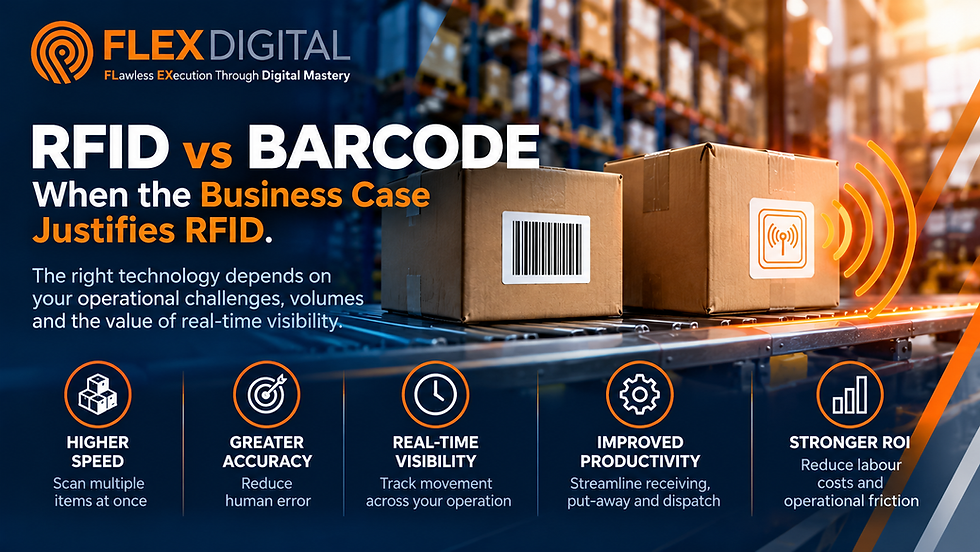
For many South African businesses, the conversation around RFID starts with the wrong question:
“Is RFID better than barcode?”
The better question is:
“At what point does the cost of manually scanning, counting, searching, correcting errors and managing poor visibility justify investing in RFID?”
Barcode technology remains highly effective. It is affordable, proven and suitable for many warehousing and manufacturing applications. RFID should therefore not be viewed simply as a replacement for barcode.
Instead, the business case for RFID emerges when the volume, speed, complexity and cost of manual processes reach a point where greater automation can deliver measurable value.
At Flex Digital Solutions, we believe technology should follow the business case — not the other way around.
Barcode Still Has an Important Role
Barcode is often the right technology when item volumes are manageable, individual line-of-sight scanning does not create a bottleneck, stocktakes are relatively straightforward and the business does not require continuous visibility of product movement.
The economics begin to change when employees spend significant amounts of time manually scanning products, searching for inventory, performing stocktakes, reconciling discrepancies or correcting receiving and dispatch errors.
This is where RFID can become significantly more valuable.
Unlike a barcode, which generally needs to be individually presented to a scanner, RFID can enable multiple tagged items to be identified without individual line-of-sight scanning.
That seemingly simple difference can transform high-volume operations.

RFID in South African Warehousing
South Africa has a substantial wholesale, retail, manufacturing and logistics economy in which enormous volumes of products move through warehouses and distribution centres every day.
Stats SA reported R308.7 billion in wholesale trade sales in March 2026 alone, illustrating the scale of goods flowing through South Africa's wholesale economy.
Consider what happens inside a busy distribution centre.
Products arrive at receiving. They are checked, counted and put away. Inventory is moved between locations. Orders are picked. Products are verified before dispatch. Returns come back into the operation. Cycle counts and stocktakes are conducted.
If each of those processes requires individual manual scanning, the cost isn't simply the barcode label.
The real cost includes labour, time, errors and operational friction.
RFID can potentially automate many of these identification points.
A pallet containing hundreds of RFID-tagged products, for example, can potentially be identified as it passes through an appropriately designed RFID read point rather than requiring an operator to scan every item individually.
The benefits can include faster receiving and dispatch, quicker stocktakes, improved inventory accuracy, fewer manual touches and significantly better visibility of inventory movement.
Think About the Cost of Every Scan
Consider a warehouse performing 50,000 manual scan events every month.
Even if each scan, verification or associated activity consumes only a few seconds, multiply that across thousands of transactions, multiple employees and twelve months.
Now add the time associated with:
Searching for misplaced inventory
Recounting stock
Investigating discrepancies
Correcting picking mistakes
Resolving receiving differences
Managing dispatch errors
Conducting physical stocktakes
Suddenly the RFID business case becomes about far more than the cost difference between a barcode label and an RFID tag.
It becomes a productivity and operational efficiency calculation.
An international example demonstrates the potential. Industrial manufacturer Bohn reported that after implementing RFID in its distribution operation, an inventory-counting process that previously took approximately six hours was reduced to around 30 minutes.
The lesson isn't that every South African warehouse will achieve exactly the same result. Every environment is different.
The lesson is that businesses need to calculate what their existing manual processes are actually costing them.
RFID in Manufacturing: Beyond Stocktaking
The RFID opportunity becomes even more interesting in manufacturing.
Here, RFID isn't simply about knowing how many products are sitting in a warehouse.
It can help create visibility across the entire production process.
Imagine automatically identifying raw materials entering production, tracking Work-in-Progress between manufacturing stages, linking components to batches and recording finished goods as they leave the production line.
Manufacturers can begin answering questions such as:
Where are my raw materials?
Has the correct material reached the correct production station?
Where is this Work-in-Progress?
Which batch was this component associated with?
Has this item completed every required production process?
Where is the finished product now?
Barcode can answer many of these questions — if somebody scans it.
RFID creates opportunities to capture many of these movements automatically.
That distinction is important in a manufacturing environment where productivity, quality, traceability and cost control are critical.

The South African Manufacturing Case
The need for productivity improvement is particularly relevant in South Africa.
Stats SA reported that manufacturing production decreased 1.7% year-on-year in June 2026, before increasing 1.1% year-on-year in July 2026.
In an environment where manufacturers are continually being asked to increase output, improve competitiveness and control operating costs, eliminating unnecessary manual processes can have meaningful financial value.
A useful international manufacturing example comes from molecular diagnostics manufacturer Cepheid.
Following the introduction of RFID into its raw-material and manufacturing workflows, the company reported eliminating more than 28,000 touchpoints and 7,000 manual transactions annually, as well as saving approximately 2,300 labour hours over nine months.
Again, those results should not simply be applied to another operation.
But they illustrate an important point:
The cost of RFID needs to be compared with the cost of the process it is replacing.
Barcode vs RFID: Don't Compare the Cost of the Labels
One of the easiest mistakes when evaluating RFID is comparing the price of an RFID tag directly with the price of a barcode label.
That misses the bigger picture.
The real comparison should include the total operational cost associated with identifying, tracking and managing the item throughout its lifecycle.
A better calculation considers:
Technology Cost + Labour + Time + Errors + Rework + Lost Inventory + Downtime + Poor Visibility
against the potential benefits of automation.
If manual scanning is inexpensive and efficient, barcode may remain the best answer.
If manual identification has become a bottleneck, RFID deserves serious consideration.
You Don't Have to Choose One Technology
Another misconception is that implementing RFID means removing every barcode.
It doesn't.
For many organisations, the strongest architecture will be a hybrid environment.
Barcode can continue handling processes where individual scanning is perfectly adequate, while RFID is introduced at high-volume or high-value points where automation produces a measurable return.
The objective shouldn't be to implement as much RFID as possible.
It should be to implement RFID where it creates value.
Five Questions to Ask Before Investing in RFID
Before deciding whether RFID is justified, start with five questions:
How many manual scans and inventory touches does our operation perform every month?
How many labour hours are spent counting, searching for and reconciling inventory?
What do inventory, receiving, picking and dispatch errors cost us annually?
Where are the biggest visibility gaps across our warehouse or production process?
What would faster, automated and more accurate data capture be worth to the business?
Answer those questions with real operational data and the RFID business case becomes much easier to quantify.
Start With the Business Problem, Not the Technology
At Flex Digital Solutions, our approach is straightforward:
Start with the workflow. Identify the inefficiency. Measure its cost. Determine where automation creates value. Then choose the technology.
Sometimes the answer will be barcode.
Sometimes it will be RFID.
And increasingly, the answer will be a combination of technologies creating an integrated environment where businesses have greater visibility over their stock, assets and operational processes.
RFID should never be deployed simply because it is more advanced technology.
It should be deployed because the business case justifies it.
Is RFID Right for Your Operation?
If your warehouse or manufacturing operation is struggling with manual stocktakes, receiving and dispatch bottlenecks, inventory discrepancies, excessive scanning, poor traceability or limited real-time visibility, it may be time to calculate the business case.
Speak to Flex Digital Solutions about assessing where RFID could deliver measurable value within your operation.
FLawless EXecution Through Digital Mastery.
Suggested SEO title: RFID vs Barcode in South Africa: When Does RFID Make Business Sense?
Suggested meta description: RFID or barcode? Discover when the business case justifies RFID for South African warehousing and manufacturing, from inventory accuracy and stocktakes to traceability and automation.


Comments