
Why RFID Is Now Right for South African Retail


How evolving technology, connected operations and measurable returns are strengthening the business case in 2026.
A customer orders a product online. Your system shows stock available, but your team cannot find it. The order is cancelled, staff spend time investigating, and the customer shops elsewhere.
For South African retailers operating across stores and online, this gap between recorded stock and actual availability has financial consequences.
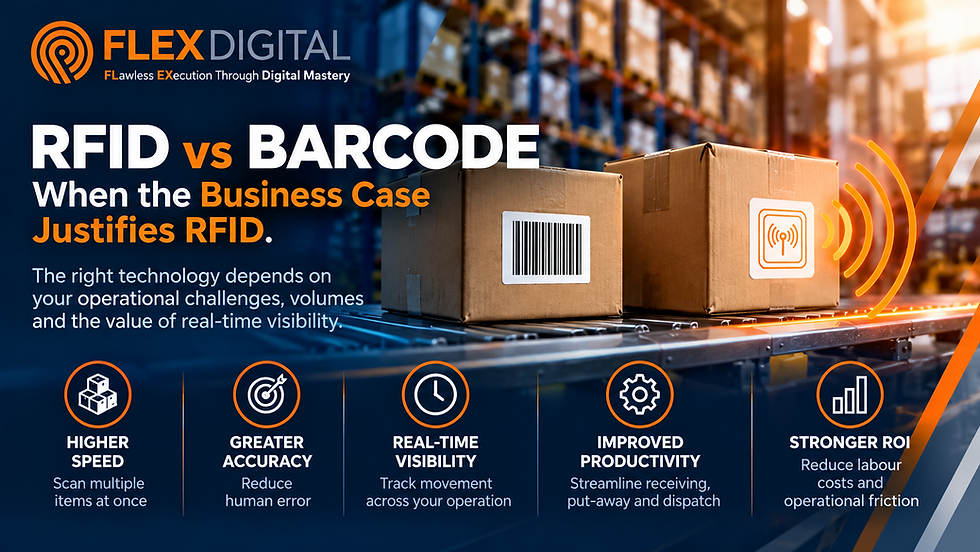
Radio Frequency Identification, or RFID, can help close that gap. By enabling faster identification and counting of tagged items, it gives businesses better information to support replenishment, fulfilment and stock control.
RFID already had successful South African applications before 2020. Today, a larger online retail market, more capable equipment and practical local implementation experience make it worth reassessing.
South African retail has changed since 2020
South Africa’s online retail sales reached R30.2 billion in 2020, according to World Wide Worx’s research.
For 2026, World Wide Worx forecasts approximately R159 billion in online sales, representing around 10% of national retail turnover. That is more than five times the 2020 value in nominal rand terms. Source: Online Retail in South Africa 2026.
This growth strengthens the commercial importance of accurate inventory. When the same stock supports store purchases, online orders and branch transfers, an inventory error can affect several parts of the business.
A product sitting unnoticed in a stockroom may become a missed sale. An incorrect stock balance may trigger unnecessary purchasing. A dispatch error may create additional delivery costs and a disappointed customer.
The implication for retailers is clear: better stock visibility can protect revenue while reducing avoidable operational costs.

What has evolved in RFID solutions?
RFID uses radio signals to identify tagged products. Suitable readers can capture multiple tags without staff scanning each barcode individually, making more frequent inventory checks practical.
These capabilities existed before 2020. In February 2019, RFID Journal reported a South African retail deployment that enabled daily stock counts, improved inventory accuracy and supported payment and loss-prevention processes. Read the local deployment report.
The case for revisiting RFID comes from developments around the technology and how businesses use it.
More capable mobile equipment. Newer reader generations offer improved battery capacity, flexible connections to mobile devices and remote equipment management. These features can make regular counting and managing devices across branches easier. See Zebra’s reader specifications.
Tagging earlier in the supply chain. Applying RFID labels at the supplier can reduce the work required when products arrive at a store or distribution centre. TFG reported enabling strategic manufacturing partners to print RFID tags onsite during its 2022 financial year, reducing production lead times. Source: TFG.
Connecting stock data to operational decisions. An RFID reading becomes commercially useful when it updates the relevant system or prompts someone to act. That might mean investigating a missing parcel, replenishing a shelf or correcting a dispatch discrepancy.
Flex Digital Solutions’ published work includes a Massmart eCommerce parcel-visibility solution and supplier-applied RFID labels for Solenco’s inbound stock. These illustrate practical applications within South African retail and distribution operations. Explore our work.
Where the business benefits come from
RFID creates value when better information changes what happens in the operation.
More frequent counts can reveal discrepancies sooner. Staff can investigate missing items while the relevant receiving, transfer or sales activity is still recent.
Better stock information can also support replenishment and fulfilment. Knowing that an item is physically available helps teams make more reliable commitments to customers and avoid unnecessary transfers or purchases.
Faster counting, receiving and checking can release staff capacity. Teams can spend more time serving customers and resolving exceptions. Where a business reduces outsourced counting, overtime or temporary labour, that improvement may also produce a direct cash saving.
RFID can support loss prevention through movement records, exception alerts and suitably designed exit controls. The benefit depends on how teams respond to the information; tags alone do not prevent every loss.
Together, these improvements can contribute to stronger margins, more dependable service and better use of working capital.

How quickly can RFID pay for itself?
Payback depends on the retailer’s stock volumes, product categories, existing systems and implementation costs. It should be calculated from measurable benefits and the full cost of ownership.
Consider an illustrative South African retailer with R60 million in annual sales.
Assume an initial RFID investment of R600,000, covering equipment, setup, integration, initial tagging and training. A pilot would need to validate the following annual benefits:
Benefit | Illustrative calculation | Annual value |
Additional sales contribution | A 1% sales uplift generates R600,000 in extra sales, at a 40% contribution margin after variable costs | R240,000 |
Lower inventory losses | An improvement equivalent to 0.3 percentage points of annual sales | R180,000 |
Avoidable operational costs | Reduced outsourced counting, overtime and temporary administration costs | R300,000 |
Total annual benefit | R720,000 | |
Recurring RFID costs | Replacement tags, software, support and maintenance | (R240,000) |
Net annual benefit | R480,000 |
The net benefit is R40,000 per month.
Simple payback = R600,000 ÷ R40,000 = 15 months.
If those assumptions hold, the initial investment is recovered after 15 months. The solution then continues contributing approximately R40,000 per month after recurring RFID costs.
Over three years:
Net benefits total R1.44 million.
Deducting the initial investment leaves a net gain of R840,000.
Three-year simple ROI is 140%: R840,000 divided by R600,000.
If the net annual benefit is half the assumed amount, simple payback extends to 30 months. Implementation delays or a gradual build-up of benefits would extend it further.
This is a worked example, not a Flex quotation, customer result or South African industry average. Figures exclude VAT, tax, financing and discounting, and assume benefits begin immediately and remain constant. Benefits must be validated separately to avoid double-counting. Staff time is a cash saving only when expenditure actually falls.
Working capital is another part of the opportunity
Improved inventory control may allow a retailer to reduce excess stock while maintaining product availability.
For example, a hypothetical business holding R5 million in inventory at cost could release R500,000 in working capital if it sustainably reduced that balance
by 10%.
That is cash released from inventory, rather than R500,000 in recurring annual profit. It could support supplier payments, debt reduction or growth. Any ongoing financing or storage savings should be calculated separately.
This potential cash release is excluded from the payback example above.
Start with a measurable South African business case
RFID deserves serious consideration where stock discrepancies, counting effort, fulfilment errors or inventory losses are material business problems.
The right starting point is a focused pilot using actual products and workflows. Measure accuracy, counting time, fulfilment errors and avoidable costs before and after implementation. Include tagging labour, integration, training, support and recurring labels in the financial assessment.
Product suitability matters too. Apparel, metal products and liquid-filled goods may require different tags and reader arrangements. Power resilience, connectivity and system integration should reflect the operating conditions at each site.
For South African retailers in 2026, the opportunity is to connect improved stock visibility with better commercial decisions—and prove the return in rands.
At Flex Digital Solutions, we help businesses digitise, optimise and automate stock management through solutions designed around their operations.
Explore our smaRTE Stock solution, or contact Flex Digital Solutions to assess the RFID business case for your retail operation.


Comments