
The Cost of Delaying RFID: What South African Retailers and Manufacturers Could Lose by 2029


The Cost of Delaying RFID: What South African Retailers and Manufacturers Could Lose by 2029
Your system says a product is in stock, but your customer leaves empty-handed. Your production schedule says an order should be underway, but your team is still searching for components.
For South African retailers and manufacturers, gaps between recorded stock and operational reality can affect productivity, cash flow and customer confidence.
Over the next three years, businesses that leave these problems unresolved could face a growing disadvantage against competitors investing in better stock visibility and control.
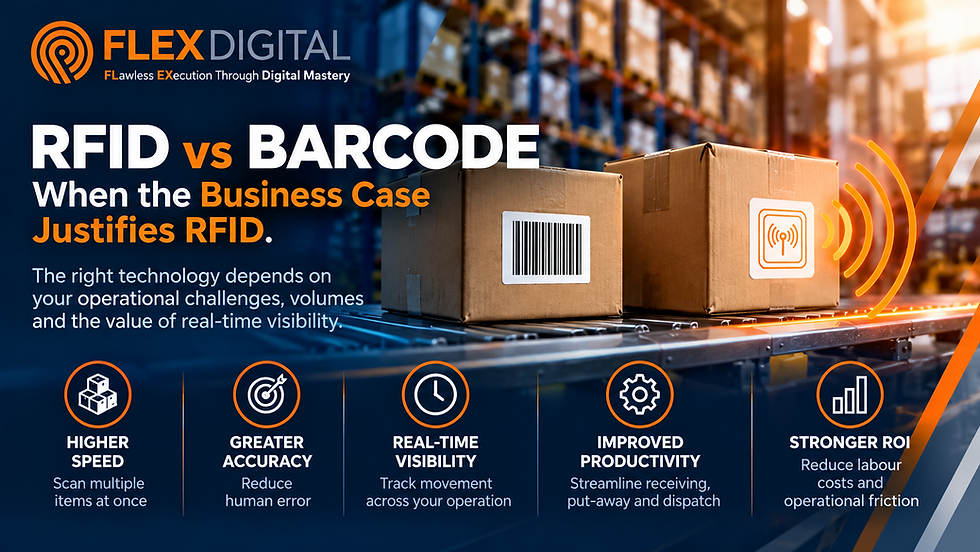
Radio Frequency Identification, or RFID, can help close those gaps. Used with the right systems and processes, it allows tagged stock and assets to be identified through radio signals, reducing reliance on individual manual scans.
The business decision is whether the value of better visibility outweighs the cost of implementing it—and how much continuing with current inefficiencies could cost.
A product can be somewhere in your business and still be unavailable to the customer who wants to buy it.
It might be sitting in a stockroom, recorded against the wrong location or missing from a shelf that should have been replenished. Meanwhile, staff spend valuable time searching instead of serving customers.
For South African retailers, this creates several operational problems:
Stock counts take time and interrupt other work.
Replenishment decisions rely on incomplete information.
Online orders may be accepted for products that cannot be located.
Discrepancies remain undetected between stocktakes.
The financial consequences extend beyond the missed sale. Excess stock ties up working capital, slow-moving products may require markdowns, and repeated searches increase the labour required to complete everyday tasks.
RFID can support faster, more frequent stock counts and earlier identification of discrepancies. When linked to inventory systems and effective replenishment processes, this can help retailers improve product availability.
There is already a South African example. In March 2024, Woolworths announced an RFID rollout covering 217 Fashion, Beauty and Home stores, with the aim of improving stock accuracy and replenishment. Read Nedap’s announcement.
For a retailer still struggling with inaccurate records, the competitive risk is clear: a customer who repeatedly finds the right product elsewhere may start shopping there first.
Manufacturing: The Cost of Keeping Production Waiting
In manufacturing, poor visibility can disrupt an entire sequence of work.
A component that cannot be located can delay an assembly task. An incorrectly identified item can contribute to rework. A missing reusable container or trolley can slow the movement of materials between production stages.
When these issues recur, supervisors spend more time resolving exceptions and less time improving output.
The resulting costs can include overtime, unnecessary purchases, urgent deliveries, excess work-in-progress inventory and missed dispatch targets. Where customer agreements include delivery penalties, delays may also create a direct contractual cost.
RFID can help identify tagged materials, assets and work in progress at defined points in the production process. Combined with production systems and controls, that information can support more reliable movement records and better process discipline.
At ZF’s Rosslyn operation, Jendamark describes using RFID-tagged trolleys with docking controls that held them in position until a process was completed. This illustrates how RFID can support control within a South African manufacturing environment. The wider system included other technologies, so its overall results should not be attributed to RFID alone. Read Jendamark’s case study.
For manufacturers competing for South African supply contracts, dependable delivery and consistent execution can strengthen the case for repeat business.
The Financial Impact: Small Inefficiencies Add Up
The cost of delaying an improvement is often spread across several budgets, making it difficult to see.
Finance sees excess inventory. Operations sees overtime. Sales sees missed orders. Customer service sees complaints.
Together, these issues can put pressure on profitability in four ways:
Lost margin: Sales that cannot be fulfilled produce no contribution towards the business’s costs.
Higher operating expenses: Counting, searching, correcting errors and arranging urgent deliveries consume resources.
Restricted cash flow: Unnecessary stock purchases leave less cash available for other priorities.
Reduced capacity: Time spent resolving preventable problems limits what existing teams and equipment can achieve.
A sound RFID business case should measure these costs against the full investment required, including tags, readers, software, integration, training and ongoing support.
It should also distinguish between cash savings and capacity gains. Saving staff time creates a financial benefit only when the business uses that capacity productively or avoids an expense.
What Your Competitors Could Gain While You Wait
Competitors that implement RFID successfully may gain more than faster stocktakes.
Better inventory information can help them make purchasing decisions with greater confidence. More reliable fulfilment can strengthen customer relationships. Fewer manual checks can give teams more time for productive work.
Those improvements create choices. A competitor might reinvest in service, increase capacity, protect margins or offer more competitive pricing.
Market share can shift through these everyday differences. A shopper chooses the retailer that reliably has stock. A purchasing manager gives more orders to the supplier that consistently delivers correctly and on time.
Over three years, repeated wins can strengthen customer relationships and make it harder for another business to win that spending back.
This is a potential competitive pathway, not a prediction of a specific market-share loss. RFID adoption alone does not determine business success, and an effective existing tracking system may already address some of these needs.
Start With a Measurable Business Problem
The strongest starting point is a clear operational problem: lengthy stocktakes, missing assets, repeated dispatch errors or poor visibility of work in progress.
Measure the current position, test RFID in a suitable area and assess the results before expanding. Tag selection, reader placement, system integration and staff adoption all influence performance.
For South African retailers and manufacturers planning towards 2029, the useful question is: Which visibility problems are costing us money today, and what would resolving them make possible?
Build Better Visibility With Flex Digital Solutions
Flex Digital Solutions helps businesses digitise stock and asset tracking, reduce manual touchpoints and automate operational workflows.
Whether your priority is stock availability, asset control or smoother material movement, better visibility starts with understanding your operation.
Contact Flex Digital Solutions to explore where RFID could deliver measurable value for your business.


Comments